Why "Eme-bala"?
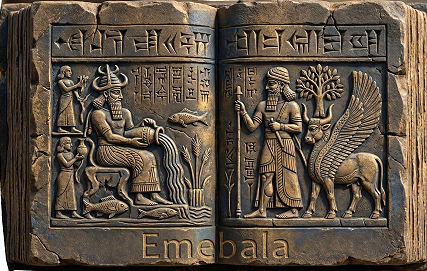
In ancient Mesopotamia, the Eme-bala were humanity's first translators — the unsung intellectuals who carried knowledge between civilizations and shaped the course of history.
Ancient Roots
"Eme-bala" is an ancient Mesopotamian term signifying humanity's earliest translators and interpreters. These key intellectuals transmitted information across civilizations — bridging the gap of human knowledge itself.
Though history rarely remembers their names, the modern world exists because of them. If Mesopotamian mathematics had never reached Greece, Pythagoras might never have emerged. If Assyrian concepts of capitalism or Persian statecraft had never crossed borders — what would our world look like?
A Personal Catalyst
During his mandatory military service in South Korea, Yongtai Kim read over 500 books. A letter requesting book donations for soldiers led a major economic federation to build a library — supplying thousands of books.
Through heartbreak, business failure, depression, and his mother's cancer diagnosis — the words of ancient and modern sages brought laughter, reasons to survive, and the power to rebuild reality. This project exists for "us" — everyone who reads for survival, growth, and enlightenment.
The Invisible Borders
Every day, an overwhelming amount of knowledge is published worldwide. Yet for book lovers, a massive barrier remains: Language.
A young Nigerian friend couldn't read a Korean entrepreneur's transformative book — because no English translation existed. Reading at 5% of native speed with a dictionary isn't living. Our lives are finite. We cannot spend all our time fighting syntax when we should be absorbing wisdom. There is a vital opportunity for AI to serve us — book lovers — rather than displace us.